Steering The AI Home
If a function contains no frequencies higher than W cps [cycles per second], it is completely determined by giving its ordinates at a series of points spaced 1/(2W) seconds apart.
~ Claude Shannon
There is a trend in motion, Oh Dear Reader, and you have probably seen the listicle version of it by now: vinyl records coming back, paper books refusing to disappear, film cameras suddenly desirable again, kids buying cassette decks and wired headphones, journals and fountain pens and board games and phone-free dinners. The lifestyle press calls it digital fatigue, or a desire for authenticity, or a return to ownership, prescribes a screen-time budget, and moves on. All true, as far as it goes.
It just does not go very far.
Because i do not think this is really about vinyl, or books, or film, or the sudden romance of an object you can hold in your hand. i think something deeper is moving underneath it, and the best place to begin is with the word itself, because the word usually knows more than the trend piece does.
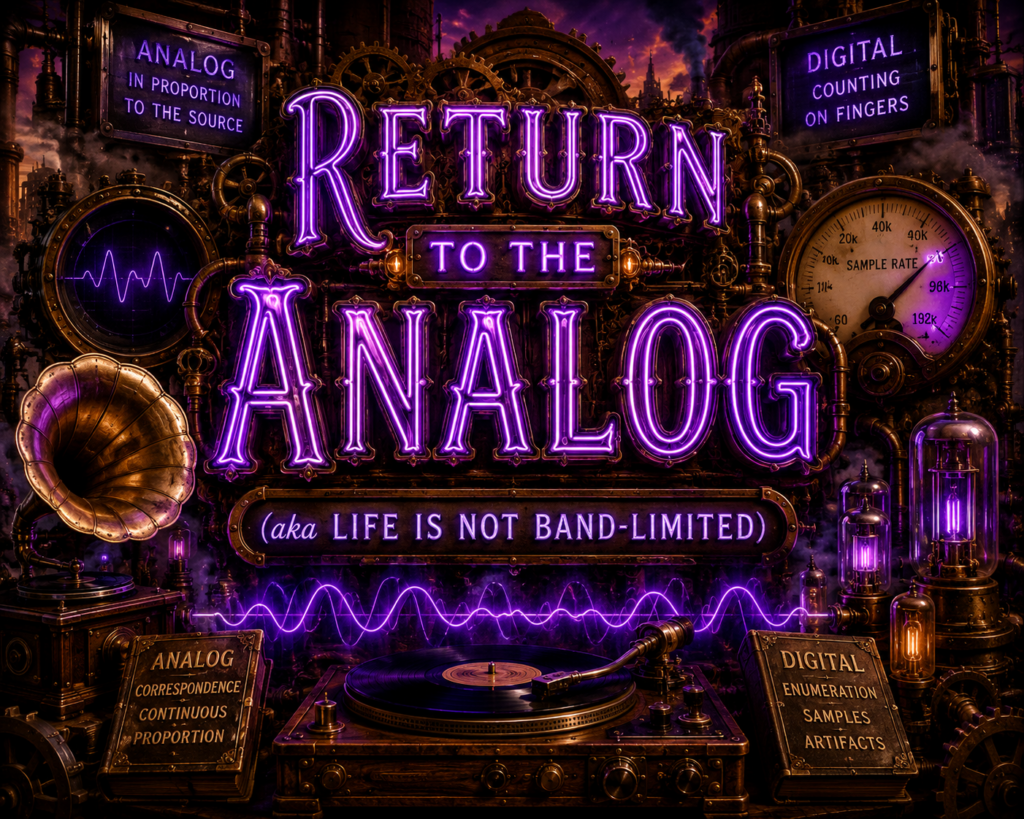
Analog comes from the Greek analogos — ana, meaning according to, and logos, meaning ratio, proportion, word, or the ordering principle. An analog signal is one that remains in proportion to the thing it represents. The groove moves as the air pressure moved. The voltage rises as the string vibrated. The speaker cone moves air in response. There is a continuous correspondence with the source.
Digital comes from the Latin digitus. Your Fingers. Counting on fingers.
Sit with that for a moment. Analog literally points toward proportion, toward correspondence with the underlying thing. Digital points toward counting. One is continuous relationship. The other is enumeration.
When we digitized the world we traded correspondence for countability, and that was an extraordinary trade. We gained perfect copies, search, recall, distribution, editing, storage, simulation, communication, computation at scales that would have looked like sorcery not very long ago. i am not interested in pretending that was a mistake.
But nobody should pretend nothing was surrendered at the border.
The quote at the top of the blog is essentially a law in signal processing that says if you sample something frequently enough, you can recreate it accurately. Take enough snapshots closely enough together and eventually those discrete measurements begin to look continuous. That idea sits underneath digital audio, digital video, telecommunications, imaging, and much of the world we now inhabit.
The important phrase, though, is frequently enough.
If you do not capture enough of the original signal, the missing information can fold back into what you do hear or see as distortion. Engineers call it aliasing. The interesting thing about aliasing is that the artifact can look perfectly legitimate even though it was created by what you failed to capture.
And life, Dear Reader, is not band-limited.
A conversation is not merely the words that were spoken. Friendship is not the messages exchanged. A concert is not the clips somebody uploaded afterward. A vacation is not the photographs. A human being is certainly not the profile. Yet we increasingly experience the world as samples of the world: the notification that was almost a conversation, the video call that was almost a visit, the playlist that was almost sitting down with the record, the highlight reel that was almost a life.
Perhaps some of what we call digital fatigue is simply the exhaustion of living through samples.
We keep increasing the resolution of the simulation while wondering why we still miss the source.
i helped create this digital wave.
There is another distinction here that matters. Analog systems tend to fail gradually (and really cool failiures). Push old tape too hard and it compresses and distorts before it completely gives up. A photograph fades. A book wears. A record acquires noise. Wood changes color. Leather cracks. The degradation becomes part of the history of the object.
Digital systems are different. They tend to remain exact until some boundary is crossed, and then the file is corrupted, the account disappears, the format becomes unreadable, the service goes away, or somebody changes the terms.
Analog tends to age.
Digital tends to work until it does not.
That difference may explain some of the attraction to physical things now. A worn book tells you where it has been. A record collection occupies actual space and survives independently of a subscription. Handwriting records the movement of a hand instead of merely preserving the letters that were chosen. These things participate in time rather than simply storing information about it.
And this is where the discussion becomes more interesting than nostalgia, because the analog is not really about old equipment. It is about continuous interaction.
Consider a fader on an old mixing console. You do not choose from a list of predetermined values. You put your fingers on it and move it while you listen. The sound changes, your hand responds, the sound changes again, and the loop closes almost below conscious thought. You are not configuring the machine so much as playing it. There may be thousands of tiny corrections inside a good mix that nobody could meaningfully write down because the performance exists in the continuous relationship between the hand, the ear, and the sound.
The wave is the same instrument at a much larger scale. A swell can travel hundreds or thousands of miles before arriving beneath you, and the face is changing while you are reading it. There are no frames. There is no menu. You commit before you possess all the information and then continuously adjust to something that is continuously adjusting to you. When you ride a wave on a board the rail of the board is continuous with you and the wave. You are either in proportion with the thing or you are not, and the feedback loop closes faster than language.
The breath hold is the third version of the same idea. Put a human body in water, hold the breath, descend, and the body begins responding continuously to pressure, oxygen, carbon dioxide, temperature, depth, and effort. Nothing is polling every few seconds to ask what state you are in. The system changes as the environment changes. The ocean changes the body and the body responds to the ocean in real time.
There is no interface between the two.
There is no undo.
There is simply the system and your place inside it.
The fader, the wave, and the breath hold appear to have very little to do with one another, but to me they are the same instrument. A continuous human coupled to a continuous system with immediate feedback and consequence. That may be why these kinds of experiences feel so different from most of the digital systems around us. The digital world increasingly asks us to select. The analog world requires us to participate.
And that brings us strangely enough to first-principles thinking.
Everybody now wants to talk about going back to first principles: strip away precedent, stop copying the accepted pattern, reduce the problem until you find what is actually true, and then build upward again. i have written my version of this elsewhere with Reduce, Refactor, Reuse and loops within loops, but notice what first-principles reasoning actually requires.
Precedent is somebody else’s sample of somebody else’s problem.
It has already been compressed, categorized, normalized, and turned into a lookup table before you arrived.
First-principles thinking means going underneath the samples and returning to the underlying thing itself. You stop asking, “How has this traditionally been done?” and start asking, “What is actually happening here?” In that sense, first principles is analog thinking. It is refusing the pre-quantized answer and going back to the source.
Which means the engineer questioning inherited assumptions and the 16-year-old buying a turntable may not be doing entirely different things. Both may be reacting to a world that has become increasingly mediated, summarized, recommended, optimized, compressed, ranked, and preselected.
Both are saying, in their own way:
Give me the thing itself.
The larger problem is that digital systems were originally interfaces to reality and somewhere along the way the interface began becoming reality. We do not merely use maps anymore; we follow the blue line. We do not simply listen to music; an algorithm chooses what comes next. We do not browse; systems predict what we should want before we know we want it. We do not need to remember very much because software remembers for us. We do not even become bored very often anymore because nearly every empty moment can be filled immediately.
Every silence can be interrupted. Every uncertainty can be searched. Every experience can be photographed before it has finished being experienced.
This is extraordinarily convenient.
It may also be why sitting with an actual book now feels vaguely rebellious.
The book does nothing.
It does not measure your engagement, recommend another paragraph, notify you of an update, or optimize itself around the likelihood that you might leave. It simply sits there until you provide the attention.
That is the distinction worth protecting. Returning to the analog does not mean rejecting the digital. That would be ridiculous. Digital technology is one of the greatest amplifiers humanity has ever created. The problem starts when amplification becomes substitution.
A photograph can amplify memory, but it cannot replace being there. A text can maintain a friendship, but it cannot become the friendship. A health metric can reveal something useful about the body, but it is not the body. A model can describe reality with extraordinary precision, but it is still not reality.
The map remains useful. Just do not confuse it with the territory.
So i am not going to give you seven habits for rediscovering analog life. i will give you the stance. Own some things. Touch some things. Write something by hand occasionally, and do not worry if the handwriting is terrible. Play the instrument badly because the wrong notes are proof that a human being is actually in the loop. Listen to an entire side of a record without touching anything. Sit in front of speakers that move enough air that you can feel the music rather than merely hear it. Put your body in actual water. Sit across from another human being without placing a glowing rectangle between you.
The point is not nostalgia. The point is proportion.
The analog never disappeared. We simply moved farther away from it, and maybe what looks like a cultural fascination with records, books, film, handwriting, craft, first principles, waves, breath, and physical experience is not a retreat into the past at all.
Maybe it is a correction.
A reminder that human beings are not databases, feeds, profiles, metrics, or collections of samples. We are continuous systems living inside a continuous world, and perhaps the reason a perfectly optimized digital existence occasionally feels strangely incomplete is simpler than we have made it:
Life is not band-limited.
You, Dear Reader, are a loud continuous signal.
Render yourself accordingly.
Until then,
#iwishyouwater <- folks gettin the memo in the deep blue.
#EverForward,stay non-linear and curious.
𝕋𝕖𝕕 ℂ. 𝕋𝕒𝕟𝕟𝕖𝕣 𝕁𝕣. (@tctjr) / X
MUZAK TO BLOG BY: Ozzy Osbourne — Diary of a Madman. Preferably played from beginning to end. On something that moves air meaning really big speakers and amps!
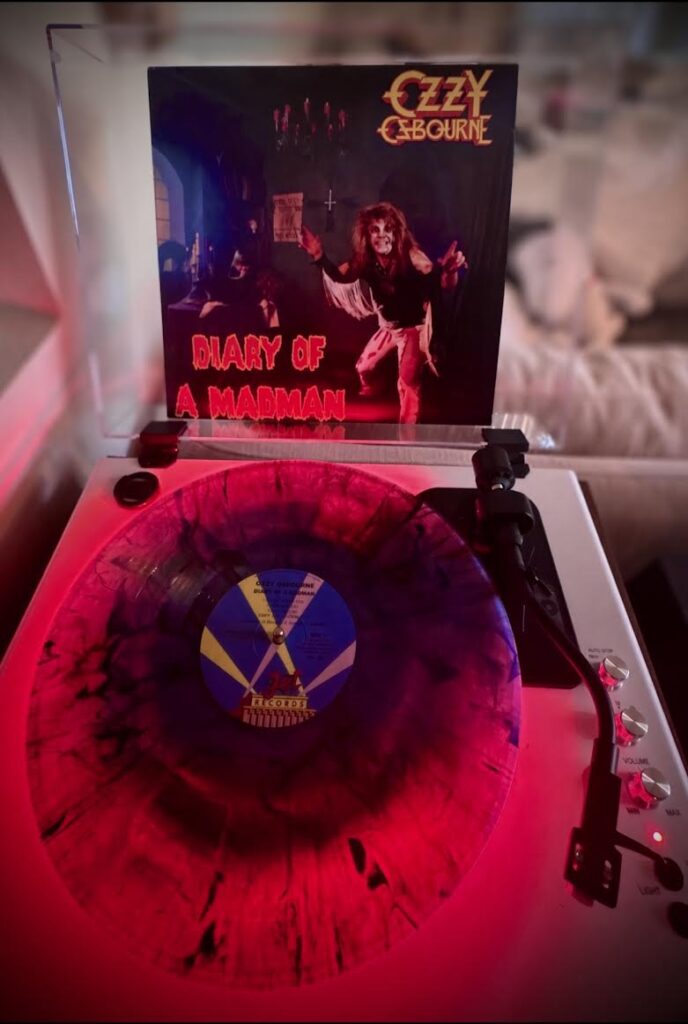
Blood Red Vinyl. Picture courtesy of TKT[2].
Note: i despised the first CD Masters of this album. Horrendous.
Discover more from Theodore C. Tanner Jr.
Subscribe to get the latest posts sent to your email.
“Listen to an entire side of a record without touching anything.” Yes. This is where my mind immediately went when I started reading.
I’m proud that today what my daughter wanted to do for her birthday was go to the bookstore and just be, browse, and read for a few hours.
Dr B^2:
Thank you so much for taking the time to read and comment. Be Proud. Be very proud. i hope to be able to sit and listen to a long playing record back to back withy ou one day. good listener partners are hard to come by these days. Also i hope y’all ate cake!
//ted
We’re like fractals repeating at different scales. Or maybe like Lego blocks who’ve lost their original instruction and so they self create that which seems most pleasing to them in the moment. Or maybe calculating probabilities of relationships within the probability of a relationship. Or maybe arriving someplace that seems strangely familiar although we’ve arrived somewhere we’ve never been before, but know we have. Or maybe que sera sera. Or maybe the constant vigilance of providing attention is enough. Wavelengths, dimensions, and frequencies derail us and keep us on track. Weird.
RomaDawn:
Thank you so much for taking the time to read and comment. You have just explained the Inifinite_Human_Do_Loop. Take a breath. Duck dive into the wavelengths. Me however doenst think its “say-ra-say-ra”.
Not sure if you saw this but reminds me of me previous blog:
https://www.tedtanner.org/no-coach-at-depth-the-autodidactic-universe/
//ted
Maybe we should seek an answer to why a neural network cannot fully simulate a biological brain by looking into why humans perceive analog and digital experience as fundamentally different.
Now take the electronic drumkit, it’s pretty clear the loss compared to an acoustic drumkit. But classical music, vs electronic music, vs live electronic music, with the crowd … it seems that appears possible to re-analogize a digital signal into a live analog experience. Even before the advent of the digital world, the music might be represented on the music sheet but ultimately what matters is the interpretation, thanks Gould. And for the sound specifically, thanks to Primus’ Brown album. “If a function contains no frequencies higher than W cps”, such an interesting premise when applied to the real world.
Ah, Professor Benoit!
Thank you so much for taking the time to read, and thank you so much for your response. Yes and you have found the move i left implicit. i think the crowd is the D/A converter. The instant sound leaves the cone it is analog again, continuous in the air, so every playback already re-analogizes. But watch closely: the room does not give back the frequencies the sample rate threw away. It adds new ones the bodies, the reflections, the player riding the machine in real time. Live electronic is not the lost signal restored. It is a fresh continuous event layered on a digital substrate. Not resampled — re-performed. Wow Gould is the complete formal verification proof. The score is band-limited; the interpretation is not. Notation is a lookup table, and he refused to read it as one. Same with the Brown album Claypool leaving in on purpose, because the grind is the proportion. The first track. The Return Of SWathington Willoubhy. The person standing next to you mkight not be who they appear to be… The Shannon clause is the whole essay in eight words. “If a function contains no frequencies higher than W cps” airtight theorem, premise nothing in a life ever satisfies. The math is perfect. Reality just declines to be band-limited. As for the net and the brain: maybe we feel analog and digital as different because we are the analog, trying to feel the seams in the counting. Maybe because its an approximation of something much larger than US. Oh and Lord Shannon made the perfect equation in addition – sum (p) log (p) forever!
être en sécurité
//ted
“When we digitized the world we traded correspondence for countability … But nobody should pretend nothing was surrendered.”
Yes, indeed. Our attention does not go to what is important, it goes to what can be measured. As Thoreau warned, we have become tools of our tools.
Mr Fox: It is not easy Mr, Fox, as the book said a long time ago. i appreciate you taking the time to read and comment. Thoreau knew what was important.
//ted