
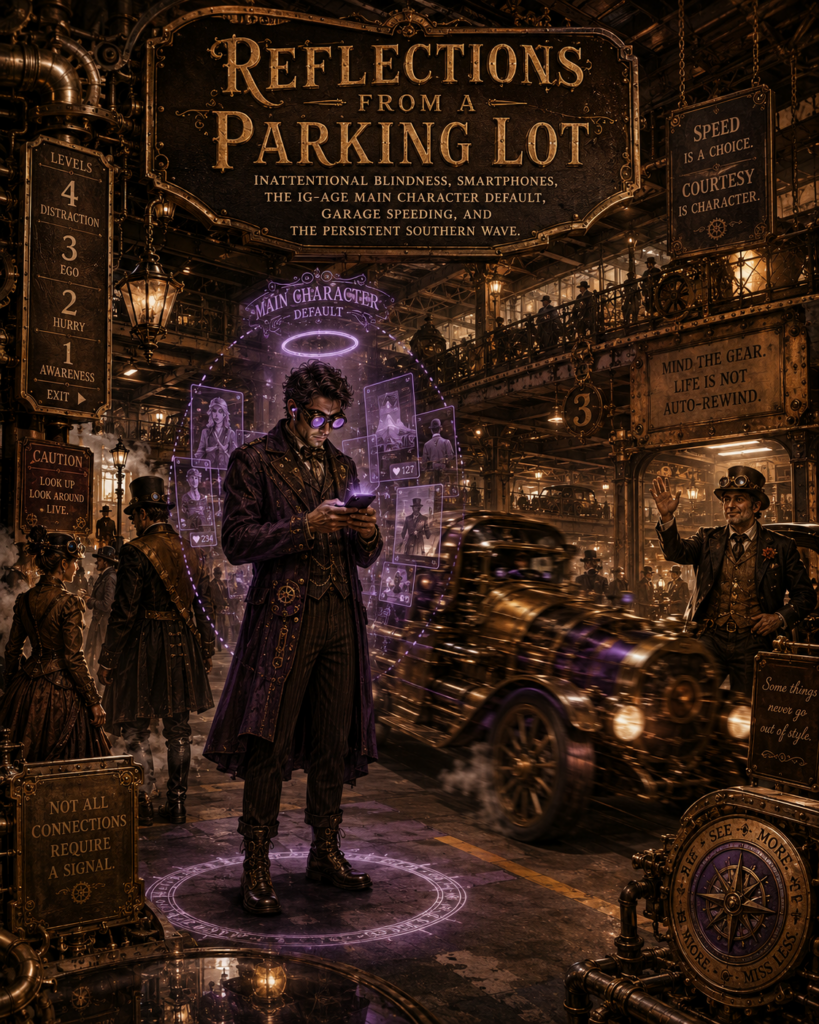
Main Character Default
I used to live in a room full of mirrors; all I could see was me. I take my spirit and I crash my mirrors, now the whole world is here for me to see.”
― Jimi Hendrix
First, i trust everyone reading this is safe. The other day i was easing into a parking spot headed to the gymnasium for yet another workout, just the usual slow creep, checking mirrors, trying not to clip anyone’s mirror or the curb when somebody walked straight into the side of my car. Head down. Thumbs moving. Eyes locked on whatever glowing rectangle held their attention. They bounced off, looked up surprised, mumbled something. i rolled down the window and said, “Going Somewhere?”. No damage. No drama. Just… contact with a moving vehicle they never saw coming.
It wasn’t rage-inducing. It was clarifying. In fact, it was HILARIOUS and ABSURD! Because i’ve been noticing it everywhere lately: people stepping off curbs into crosswalks without a glance left or right, crossing busy streets while scrolling like the physical world is optional. And on the flip side—drivers in parking lots treating them like short highways, zipping through without the full left-right-left scan we were all taught in driver’s ed, or backing out blind because their attention is split between the wheel and the passenger seat phone. Low-speed zones, high inattention. It feels like we’re all moving through shared space on partial autopilot (complete autopilot possibly?).
Lo and behold, after some sleuthing ye ole noggin doctors, those Psychologists have a precise term for the phone part of this: inattentional blindness. Read that again. Wow.
It’s not new. The classic “gorilla in the room” demonstration showed how dramatically our brains filter out the unexpected when attention is narrowly focused elsewhere. But smartphones turned this from a lab curiosity into everyday infrastructure. However, monkeys are funny; this is not funny.
In 2010, psychologist Ira Hyman and colleagues ran a now-famous field study on a college campus. People walking and talking on cell phones were significantly less likely to notice a unicycling clown riding across their path—complete with wig, red nose, and unicycle—than people not on phones. Many literally walked right past the clown and, when asked afterward, had no memory of anything unusual. The phone didn’t just divide attention; it created a tunnel. Later observational work has reinforced the pattern: pedestrians actively using smartphones show measurably reduced awareness of their surroundings.
The crash data is more mixed but still sobering. Pedestrian fatalities in the U.S. have been climbing for well over a decade (a reversal of earlier safety gains), with notable elevations around the pandemic years. Multiple factors are at play—larger vehicles with higher hoods that hide more of the road ahead, infrastructure that prioritizes speed, driver speeding and impairment, and yes, distraction on both sides of the windshield. Distracted walking is estimated to contribute to a meaningful but not dominant slice of incidents. It’s rarely the only thing, but it’s a controllable amplifier in an already risky system.
What has changed since the pandemic, i suspect, is the baseline level of the distractor itself. Screen time surged during lockdowns—recreational screen use for many adults and especially kids jumped by an hour or more per day on average, with much of it persisting even after restrictions lifted. We spent years conducting large parts of life through rectangles: work, socializing, entertainment, news, comfort. The habit didn’t vanish when we re-entered physical spaces.
Notifications still ping. The feed still scrolls. The pull to “just check one thing” remains engineered to be irresistible. In transitional, high-stakes environments like streets and parking lots—where you need rapid, wide situational awareness—the cost of that tug is suddenly visible in the form of near-misses and the occasional gentle bumper-to-person collision.
And it’s not only the phones. In the Instagram age or as i call it: Duh-Gram, this era of constant self-curation, story arcs, and what people are now calling “main character syndrome,” there’s a noticeable layer of entitled, almost narcissistic maneuvering in shared spaces. i’ve watched people pull right up beside me mid-maneuver in a tight lot, eyes forward or on their own reflection in the rearview, never once making eye contact or offering the smallest wave or nod that another human being exists in the vehicle next to them. Or they’ll swoop into a spot you were clearly waiting for or angling toward, no blinker, no glance back, as if the entire parking infrastructure and everyone in it are merely scenery for their personal errand montage.
The space isn’t shared; it’s theirs by default. Public pavement becomes an extension of the personal feed rather than a place requiring basic mutual recognition and courtesy.
What really fascinates—and frankly baffles me is the speeding inside parking garages and structured lots themselves. These are environments explicitly designed for crawling speeds: posted limits are typically 5–10 mph (sometimes up to 15 mph in larger commercial structures), with tight turning radii, pillars that create constant blind spots, ramps that drop or rise abruptly, low ceilings, poor sightlines around corners, and pedestrians or other vehicles appearing from every angle without warning. Yet i regularly see people treating the long straight aisles like surface streets, accelerating down ramps as if making up lost time on a commute, or maintaining highway-like momentum through the internal intersections of the garage. Even 35 to 40 mph in those confined, echoey, pillar-studded spaces feels dangerously fast because reaction distances are measured in a handful of feet, not hundreds.
A little history note here: When myself and others were working at a place called MicroSoft (small flacid anyone?)circa 2001, we used to count people who sped in parking lots and note car and license plate. Sometimes we had a casual discussion with them. One time i was “touched” by a car that was speedind. My backpack had broken the strap and i reached down (after watching both ways) and the person careened around the corner and almost “vanished me.” We had a discussion and he no longer sped.
One in five reported vehicle crashes happens in parking lots and garages; hundreds of people die and tens of thousands are injured in them every year. Many of those incidents are low-speed on paper, but the ones involving higher speeds inside the garage multiply the damage, injury risk, and sheer chaos dramatically.
Why does this happen? i genuinely don’t fully understand it. Is it simple carryover habit from open-road driving, where momentum feels normal? Time pressure that makes even a two-minute garage traversal feel like lost productivity?
Is this how YOU feel exhilarated and alive? How boring. (of course i am talking to you – who else?)
For the most part people are not curious except about themselves.
― John Steinbeck
Overconfidence from driving the same familiar structure every day? Or does the main-character default kick in hardest here: “the garage exists to get me in and out as quickly as possible, so everyone else better clear the way or get out of my story”? Whatever the mix, it turns every other problem (phone distraction, not looking, cutting in without signals or acknowledgment) into higher-stakes events. A distracted walker or an entitled lane-swiper becomes far more dangerous when the closing speed is elevated in an environment never meant for it.
Interestingly, this basic acknowledgment hasn’t entirely disappeared everywhere. In the South, it is still common for people to wave at each other—even when driving or pulling out onto two-lane roads—and especially to offer a small nod or wave when cars are maneuvering just inches apart in tight lots or garages. That tiny gesture says “i see you” in a space where modern defaults often render the other person invisible. It keeps the interaction human rather than purely transactional or oblivious.
Actually i believe there might be ten different ways to “acknowledge the other human” in the South.
Parking lots and garages are especially weird little ecosystems. Cars move in every direction at once. Pedestrians appear between bumpers or from stairwells. Sightlines are terrible by design. Everyone is either rushing to the next thing or already mentally checked into it via their device—or into their own starring role. Speeding through them is reckless. Not looking up from the phone (or from your own main-character script) while crossing or claiming them is equally so. Both are forms of the same underlying issue: fragmented or self-centered attention in an environment that punishes fragmentation with expensive metal, injured bodies, and frayed nerves.
Meditation is a way to be narcissistic without hurting anyone.
― Nassim Nicholas Taleb
On the same day, coming out of a garage, four cars in a row where I did have the right-of-way from a road rules standpoint came in the garage, and each within inches of my car turned in front of me, with the four drivers never meeting eye contact but looking straight ahead while they were turning.
It is literally NPC (non-player character) behavior in a game.
Beyond the safety numbers, though, there’s a quieter cost. We’re practicing not being fully here and not fully registering that others are here too. Missing the small negotiations of shared space—an eye contact, a slight course correction, a muttered “sorry,” or even just the basic signal that says “i see you and i’m adjusting.” In a culture optimized for continuous partial attention and personal branding, choosing full presence plus basic courtesy in public feels almost countercultural.
The Stoics would probably call attention one of the few things truly in our control; modern platforms and the performative habits they reward make that control feel optional or even quaint. Speeding in a space literally built to force slowness reveals a deeper miscalibration: we’ve stopped reading the environment’s clear cues that say “this is not a through-road; this is a careful, shared transition zone.”
i’m not arguing we throw the phones in a lake (maybe shoot them with a full metaljacket .223 AR15 at close range…) or that every driver under 35 is a narcissist. Phones are powerful tools, maps, lifelines, and sometimes the only thread keeping us connected to distant people we love. Social media didn’t invent self-interest; it just amplifies and normalizes certain versions of it.
But maybe, in the narrow slices of life where bodies and machines share pavement, especially inside the concrete echo chambers of parking garages, we can run a quick software patch on ourselves: phone down and ego down for a moment. Look up. Signal early. Ease off the accelerator. Offer the small wave or nod when you’re two inches from another car or pulling out onto the road. Treat the parking lot or garage like the high-stakes, multi-agent, shared environment it actually is.
The automobile is the most dangerous weapon in our society—cars kill more than wars do.
~ Ray Bradbury
It won’t solve bigger design and policy problems around vehicle size, street design, or speed. Those need attention too. But it’s one of the few levers each of us can pull immediately. And it might just make the shared world feel a little less like we’re all walking (or driving) through it half-blind and half-convinced the story is only about us—and a little more like the place where people still occasionally remember to wave.
A suggestion: look both ways—and up. Offer The Wave. Acknowledge the extras in your scene. And for the love of everything, ease off the gas inside the garage.
Or just keep doom scrolling when you drive. For those “Bless Yall’s Hearts, ” To no end until The End.
#iwishyouwater <- Getting the memo in Bali
Ted ℂ. Tanner Jr. (@tctjr) / X
MUZAK TO BLOG BY
Once in a Lifetime by Talking Heads.
Sing it with the following lyrics!
Because you may find yourself in a parking garage. Behind the wheel behind a large automobile, you may find yourself accelerating down a ramp you’ve taken a hundred times. You may ask yourself: why am i treating this concrete maze like an interstate when everything around me is screaming “slow down and notice the other person two inches away”? And you may tell yourself: this is not my beautiful, fully present, other-aware attention span. Wait, how did I get here? Letting the miles go by…
Note: Go watch Death Race 2000 with Charles Bronson.
Note: i saw a bumper sticker the other day – “I’m not texting i am reloading.”