Curiosity is the lust of the mind.
~ Thomas Hobbes
First, i trust everyone is safe.
Second, i recently discovered i have 26 patents granted to my name. Ok, so what? Yay me. i am not saying look at me, no that is nott the point. The recent unknown “number of somethings created” made me Wonder about “Wonder and Curiosity”. Why did i go create that stuff in the first place? i cannot really say other than i was Curious to invent and build.
i have been wondering about curiosity and creativity a lot lately due to the acceleration of Plain/Artificial/Super Intelligence. i in fact have not been able to put the question down as of late: Can you teach curiosity? Not encourage it. Not reward it. Teach it, as in “put it into someone or something” who does not have it. Stick an Secure Digital Card in your mouth; Violá! You have Curiosity!
My first answer was no. My second answer was also no, but for a better reason, and the better reason is this whole post.
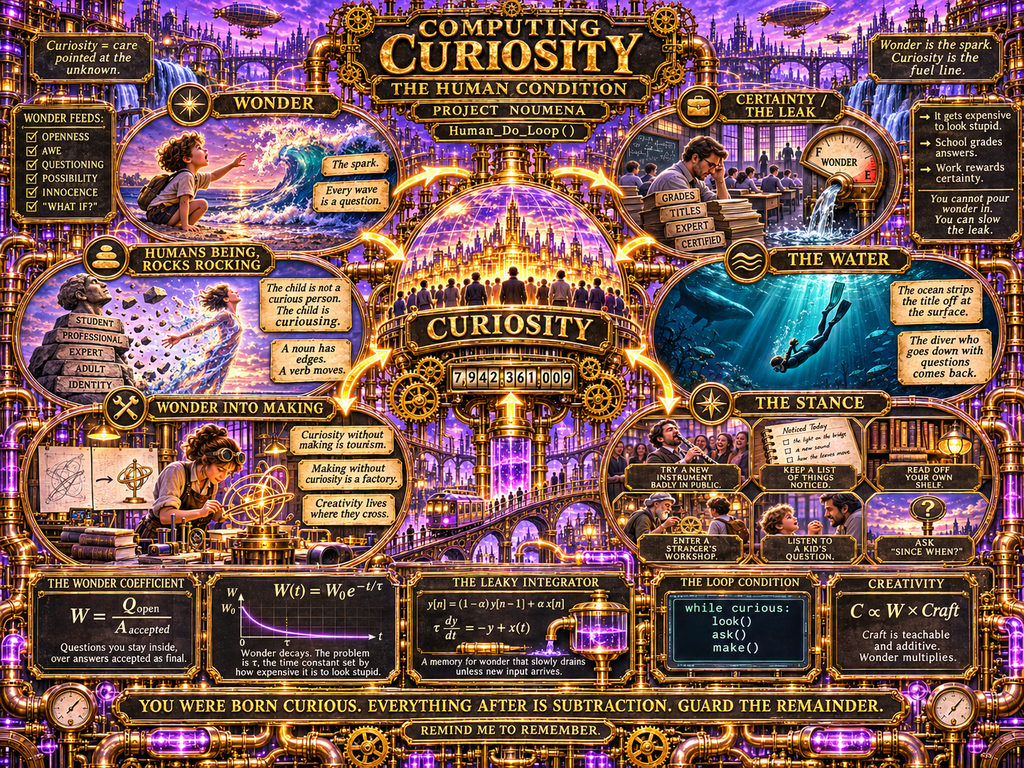
This one runs twice, Dear Reader. The first pass is in plain words, i trust, for anyone to understand. The second pass is the same loop again with the math showing. Same body, next iteration: the Human_Do_Loop. Get off after the first pass and you have lost nothing and hopefully gained somthing. the second pass through the loop: Can We Compute IT?
The Word Itself
i always start with the word, Dear Reader, because the word usually knows more than we do.
Curiosity, from the Latin curiosus: careful, diligent, inquisitive. Which comes from cura: care. The same root gives us cure, and curator. To be curious originally meant to take care, to pay the kind of attention you pay to something you are responsible for. Somewhere along the way the word drifted toward meaning nosy. The original is better.
Curiosity is CARE pointed at the UNKNOWN.
Wonder, from the Old English wundor: a marvel, a thing that stops you in complete awe and amazement.
Hold those two. Wonder is the spark. Curiosity is the fuel line. One happens to you; the other is what you do next.
i prefer the Old English version; candidly, i think i should have lived in the early 1800s. Maybe i did once?
Iteration One: Plain Words
The Leak
Watch a three-year-old at the waterline. Every wave is a question. Every scintillating star off the water. Where did it come from? Why does it come back? Where does the foam go. Can i catch it? Can i catch it again? Nobody taught that child to ask. It arrived pre-installed.
Every kid arrives full of it. What changes is not how much Curiosity we start off with in the life. It is how fast it drains out of our very nature of living. It drains for one reason above all: it gets expensive to look stupid. School grades answers, not questions. Work promotes certainty and the illusion of safety. The feed rewards the take, never the question. Every year a little more certainty goes in and a little more wonder leaks out. Not because we got dumber. Because we got certain. We think we are safe and secure.
So the question changes. You cannot pour wonder in. You can slow the leak.
We keep moving forward, opening new doors, and trying new things, because we are curious and curiosity keeps leading us down new paths.
~ Walt Disney
Humans Being, Rocks Rocking
Alan Watts had a habit of turning nouns back into verbs. His point, roughly: you are not a thing that does things. You are something the whole universe is doing, the way a wave is something the ocean is doing. Humans being. Rocks rocking.
The child has not learned the noun yet. A three-year-old is not “a curious person.” A three-year-old is curiousing. It is the verb, all the way down.
Wonder is the feeling of a philosopher, and philosophy begins in wonder.
~ Plato, Theaetetus 155d (Jowett translation)
Then we get nouned. Student. Accountant. Doctor. Engineer. Expert. CTO. A noun has edges, and edges need defending, and nothing defends itself like an expert. A verb does not defend. It moves.
The water taught me this before any book did. At depth or on a wave you cannot be a noun. The ocean strips the title off at the surface and asks the same question every paddle out, every dive, and it does not care who you were on land. The surfer or freediver who paddles out and or dives down with answers gets hurt. The surfer or freediver who paddles out or dives down with questions comes back. There is no coach during the process, and there is no expert there either – please trust me.
Curiosity is not one more thing you do inside your life. It is what keeps the loop running. When it stops, the loop exits, even if the body keeps breathing. That is the rock that stopped rocking.
Wonder Into Making
Curiosity without Creating is tourism. i have others call it cookie-licking at a party. Making without curiosity is a factory. Creativity lives where they cross: you notice something, you stay with it past the point where it is comfortable, and then you give it a shape. The making is just the noticing you refused to let go of.
“I Wonder, I Wonder, What Would You Do If You Had The Power To Dream Any Dream You Wanted?”
~ Alan Watts
Craft can be taught. Practicing music scales, language syntax, martial art forms, the thousand hours over and over. Wonder cannot be put in, but it multiplies everything craft does. A master with no wonder left produces competent repetition, mechanization at scale. A child with endless wonder and no craft produces a thousand beautiful starts. The rare thing, the thing i believe humanity references and actually means when we say creative, is both at once: the hands of an adult and the questions of a kid.
Wonder is not a reserve you spend down once. It is more like a memory that fades unless something new keeps arriving. Stop feeding it and it quietly forgets.
Somewhere, something incredible is waiting to be known.
~ Carl Sagan
A suggested few things that keep feeding IT and slow the leak, from someone still working on IT:
- Do something badly in public. A new instrument, a new language, a new ocean.
- Keep a list of things you noticed, not things you did.
- Read off your own shelf. The book that does not fit your categories is the one that grows them.
- Go where your title means nothing: the water, a stranger’s workshop, a kid’s question.
- When someone presents something new look at what it accomplished not what it did not do then improve it.
- When you hear yourself say “i know,” ask “since when?”
The Stance
So, can you teach curiosity?
No. You cannot put it in. Everybody already has it; it came with the hardware.
What you can do is stop taking it out. You can make it cheap to look stupid. You can ask the question out loud first, so the room learns it is allowed. Kids pick up curiosity the way they pick up an accent: by living around it. That is teaching, just by subtraction instead of addition.
If you are the one whose loop is flickering or waning, the fix is the same. Find the place where the noun does not follow you, and go be a verb there for a while.
Iteration Two: Same Loop, Now With Some Math
For those that like to see the gears. Nothing new is claimed here. It is the same argument with the variables named. In fact, it’s probably nowhere correct. Please, all you PhDs, help this mutt out, will you?
The Wonder Coefficient
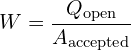
The questions you are willing to stay inside, over the answers you have accepted as final. A child’s denominator is nearly empty, so W is enormous. An adult’s denominator is crowded with settled answers, so W shrinks toward nothing.
And it decays:

W₀ is not the problem. Everybody gets a big one. The problem is τ, the time constant, set by how expensive it is to look stupid. Iteration one called it the leak. This is the leak with a number on it.
Much of what I stumbled into by following my curiosity and intuition turned out to be priceless later on.
~Steve Jobs
As i said this is a model, not a measurement. Nobody has published a wonder coefficient and i am not going to pretend otherwise. But the shape is right, and the shape changes the question. Q: Can install W₀? Can you lengthen τ?
The Leaky Integrator
Signal processing has a name for a memory that slowly forgets: the leaky integrator.

Each step it keeps a fraction (1 − α) of what it remembered and lets in a little of what is new. Stop feeding it and the memory drains away with a time constant of roughly 1/α steps. In continuous time it is the same thing:
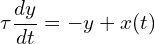
Same τ as the wonder coefficient, wearing a different costume. Wonder is the input x. Curiosity is the integrator y. If nothing new comes in, it forgets on schedule. Remind me to remember is just a demand that x never go to zero.
The Loop Condition
For those that have been here a while, the Do-Loop version:
while curious:
    look()
    ask()
    make()
Curiosity is not something inside the loop. It is the loop condition. When it goes false the loop exits, even if the body keeps breathing.
Creativity

Craft is teachable and additive. W is not teachable and it multiplies. Drive either one to zero and the product goes with it. That is the whole of iteration one, in one line.
#TCTRules: You were born curious. Everything after is subtraction. Guard the remainder.
MUZAK TO BLOG BY: Brian Eno, Another Green World. A record made by a man who wrote himself cards that said, more or less, try the thing you would not try. [swap in your own pick]
Until then,
#iwishyouwater <- Opening day at my beloved HMB. Man, I get goosebumps when I hear that NOAA report voice….
Stay Curious, Stay Non-linear, #EverForward,
𝕋𝕖𝕕 ℂ. 𝕋𝕒𝕟𝕟𝕖𝕣 𝕁𝕣. (@tctjr) / X
Discover more from Theodore C. Tanner Jr.
Subscribe to get the latest posts sent to your email.